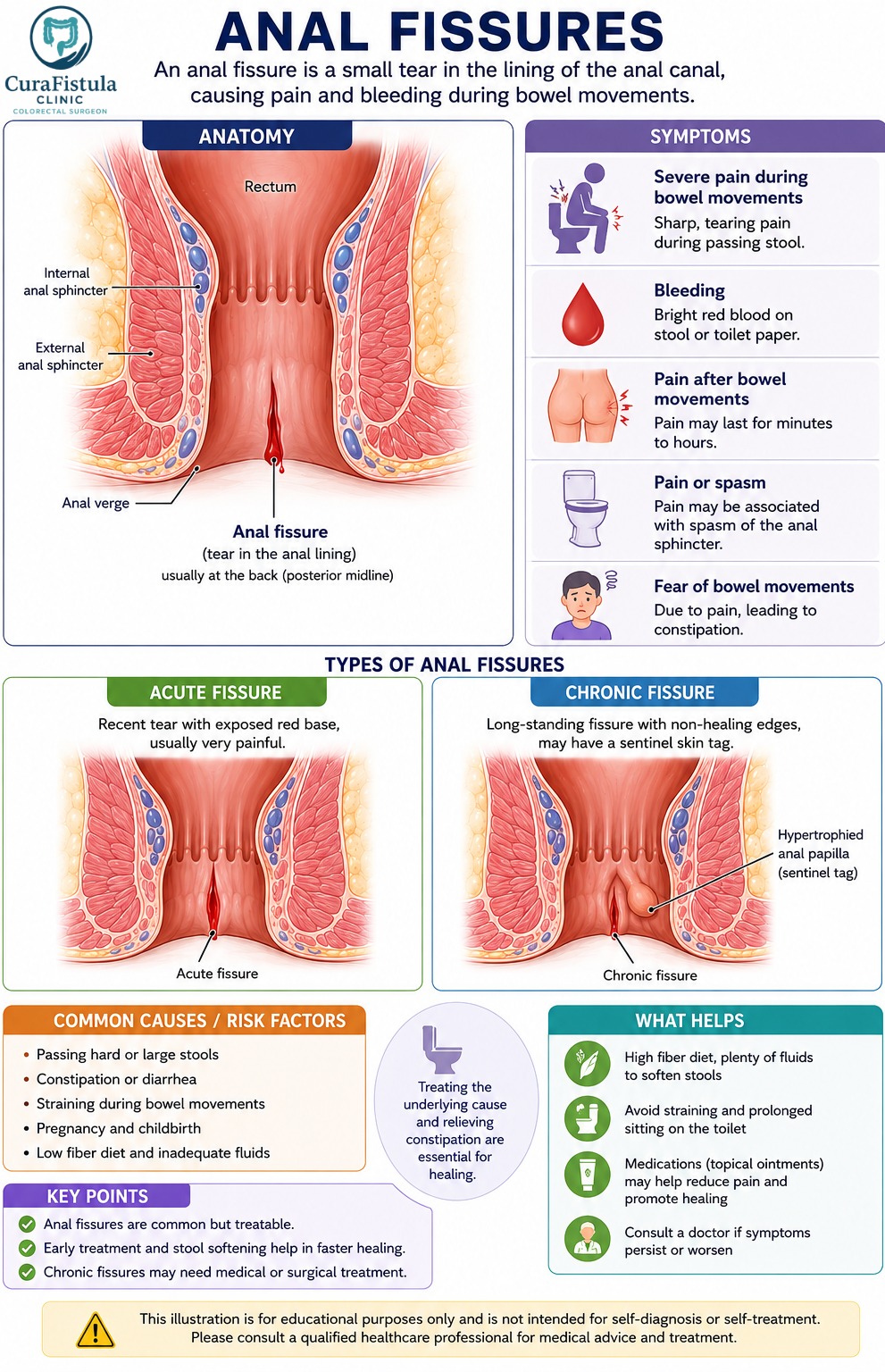
Anal pain during bowel movements can make patients anxious about every visit to the toilet. When the pain repeats daily, constipation and fear of passing stool can further complicate the situation.
An anal fissure is one possible cause of this pattern and can often be identified through appropriate clinical assessment.
Signs That a Fissure May Need Specialist Evaluation
A recent fissure may improve with appropriate conservative management, but assessment becomes increasingly relevant when:
- Pain persists or repeatedly returns
- Bleeding continues
- Constipation remains difficult to control
- Symptoms have not responded to prescribed treatment
- The diagnosis is uncertain
- A fissure appears chronic
- Previous treatment has failed
- Surgery has been suggested and another detailed evaluation is needed
Persistent symptoms do not automatically mean that surgery is required.
What Should Happen Before Treatment Is Chosen?
A colorectal consultation should clarify whether the pain is actually caused by a fissure.
Other anorectal conditions can produce pain, and some require different management. The doctor may evaluate the appearance and location of the fissure, duration of symptoms and other relevant findings.
Bowel habits and stool consistency are also important because repeated passage of hard stool can interfere with healing.
What Treatment Options May Be Discussed?
Management depends on whether the fissure is acute or chronic and on individual clinical factors.
For suitable patients, treatment may initially include measures aimed at producing softer, easier bowel movements and reducing repeated trauma. Prescription medicines can also be used in selected cases.
When a chronic fissure remains symptomatic despite appropriate treatment, additional options may be considered.
Lateral internal sphincterotomy is an established surgical treatment for selected chronic anal fissures. It involves dividing part of the internal sphincter muscle to reduce sphincter pressure.
Because sphincter function contributes to continence, surgical suitability and potential risks should be discussed individually rather than assuming that the procedure is appropriate for everyone.
Preparing for a Colorectal Consultation
Patients can make the discussion more productive by describing when the pain occurs, how long it lasts after bowel movements, whether bleeding occurs and which treatments have already been tried.
Any previous anorectal operations and existing continence concerns should also be discussed.
Dr. Atef J. Baakza provides evaluation of fissures and other proctological conditions in Mumbai. For patients travelling from locations such as Tardeo, Mahalaxmi, Mumbai Central and other parts of Maharashtra, consultation can clarify whether continued conservative management or procedural treatment should be considered.
Persistent anal pain deserves a diagnosis rather than repeated self-treatment. Once the cause, chronicity and relevant clinical factors have been established, treatment can be selected according to the individual patient's needs rather than relying on a one-size-fits-all approach.
Keywords