Recurrence is one of the most frustrating experiences for someone who has already undergone treatment for an anal fistula. Symptoms may disappear for a period and then return as swelling, discomfort or drainage from the same or a nearby area.
Several factors can contribute to recurrence, which is why a returning fistula deserves reassessment rather than assuming that exactly the same treatment should simply be repeated.
The Tract May Be More Complicated Than It Appears
An Anal Fistula is not merely the external opening visible on the skin. The tract extends internally and may have branches or secondary extensions.
If the anatomy is complex, treatment planning needs to account for the relevant pathways.
The fistula's relationship with anal sphincter muscles is also important. A treatment that addresses disease while preserving continence may require careful balancing of these considerations.
Previous Surgery Changes the Clinical Picture
Scar tissue from previous operations can alter local anatomy.
When seeking evaluation for recurrent symptoms, bring previous surgical records, imaging and discharge summaries when available. Knowing exactly what procedure was performed can help the surgeon understand the current problem.
Patients should also describe whether symptoms disappeared completely after treatment or whether intermittent drainage continued.
That distinction can provide useful clinical information.
Could There Be Another Underlying Factor?
Most fistulas are associated with infection originating from anal glands, but fistula-like disease can sometimes occur in association with other medical conditions.
A recurrent or unusual presentation may therefore prompt the doctor to consider whether additional assessment is necessary.
This does not mean every recurrent fistula indicates another disease. It means the clinical context should be considered rather than focusing solely on the external opening.
What Should Reassessment Include?
Depending on individual circumstances, evaluation may involve:
- Detailed history of previous abscesses
- Review of earlier operations
- Examination of the anal and perianal region
- Assessment of sphincter function and relevant symptoms
- Imaging where clinically appropriate
- Discussion of possible treatment approaches
For a straightforward fistula, extensive investigation may not always be necessary. Complex or recurrent cases can require more detailed mapping.
Avoid Choosing Treatment by Procedure Name Alone
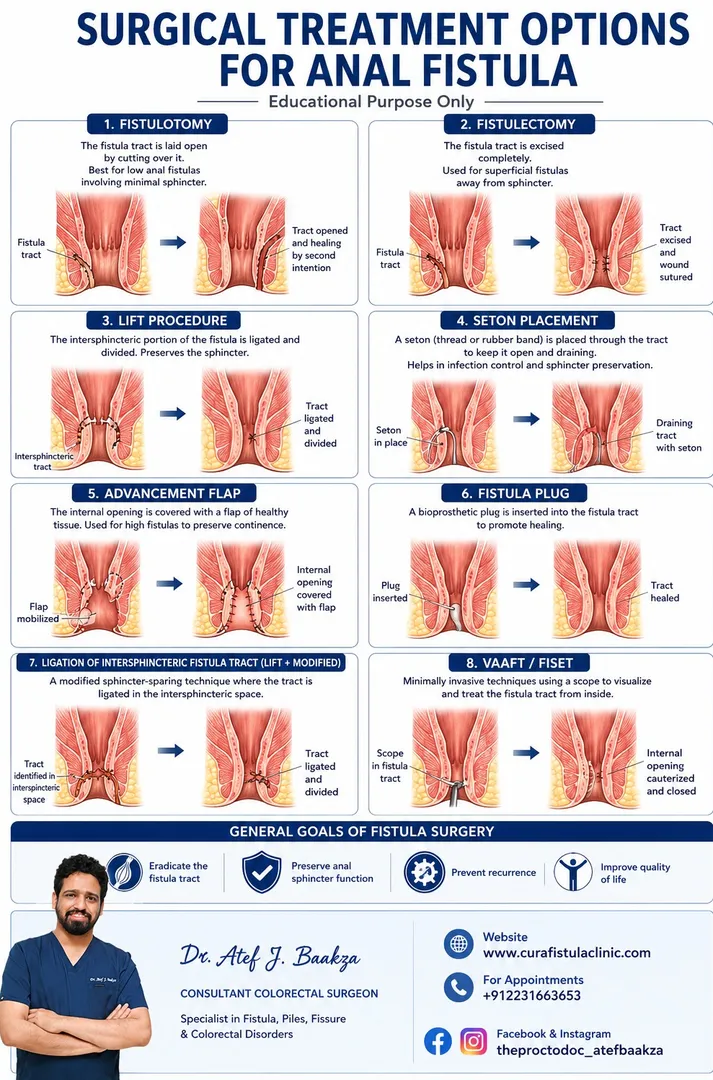
People in Mahalaxmi and other parts of South Mumbai may encounter information about multiple fistula procedures. No single technique is automatically appropriate for every tract.
Dr. Atef J. Baakza assesses recurrent and other anal fistulas in Mumbai with attention to their clinical and anatomical characteristics.
For a patient whose fistula has returned, the useful question is not simply, 'Which procedure is best?' A more meaningful question is, 'Why did the symptoms recur, what does the tract look like now, and which treatment is appropriate for this anatomy?'
That approach supports a more individualized treatment discussion.
Keywords